A white sun hangs on the
arch of heaven as purple mountains rest beneath a veil of dust. Shrubs sway,
grasses wither, and sun-bleached skulls lie scattered across the desert floor.
The Jornada del Muerto is many things: a parched basin at the northernmost
reaches of the Chihuahuan Desert, a United States Department of Agriculture
experimental range, and an ancestral homeland. Yet to those who find themselves
enveloped by its 3,000-square-mile expanse, it feels most like a liminal space,
detached from the rhythms of the outside world and seemingly of little
consequence.
The uniformity of the vast
landscape gives no indication that this is a place of transformation. Fragments
of Jornada Mogollon pottery hint at a time when rains were more reliable
and cultivation flourished. Today, Interstate 25 closely follows El Camino
Real de Tierra Adentro, the inland corridor that served as one of the
earliest gateways to the New World, carrying new peoples, livestock, and
beliefs. The Jornada bore silent witness as these transformations gave rise to
profound conflict. Following the Pueblo Revolt of 1680, the same conquistadors
who had pressed north were defeated and exiled, prompting the Spanish Crown to
temporarily abandon New Mexico as a lost cause. More than two centuries later,
the Jornada del Muerto, or “Dead Man’s Journey,” a name bestowed by
the Spanish for the hardships of its crossing, again became center stage for
the birth of a new world. In July 1945, a second sun illuminated the night with
the first detonation of a nuclear weapon.
Today, the Jornada del Muerto and the wider world continue to change in tandem. Shrublands aggressively encroach as grasses retreat, temperatures climb alongside tempers, and persistent winds strip away the common soil that sustains us. As scientists, we strive to understand change without bias, yet our work is inevitably shaped by the questions, methods, and institutions inherited from our predecessors. Science itself aspires to impartiality, but the motivations that guide it do not. The questions we ask are reflections of the societies in which we live. It is tempting to believe that we are more enlightened simply because we belong to a more modern age, but history offers little support for such confidence. We are no less human than our predecessors. We are equally fallible, driven by the same fear and hope that tomorrow will be different.
My own work seeks to understand wind erosion, driven by the hope that ecological disasters like the Dust Bowl of the 1930s remain confined to the history books. Yet the science I practice is inseparable from the world that produced it. The towers and instruments I rely upon also serve military ambitions, aiding efforts to understand the atmosphere for purposes ranging from environmental forecasting to battlefield operations. It is the condition of every generation to inherit a world already in motion, shaped by choices made before our arrival. What remains within our power is not the past we received, but the future we leave behind. The Jornada has hosted such transformations before. From ancestral Puebloans whose corn flourished with abundant rains, to colonial empires that rose and collapsed beneath its sun, to the blinding flash of a new and terrible beginning. The Jornada does not judge, it only endures. Perhaps this is the most honest measure of our work: not whether we transcended the limitations of our time, but whether the questions we ask leave the next generation a world worth inheriting.
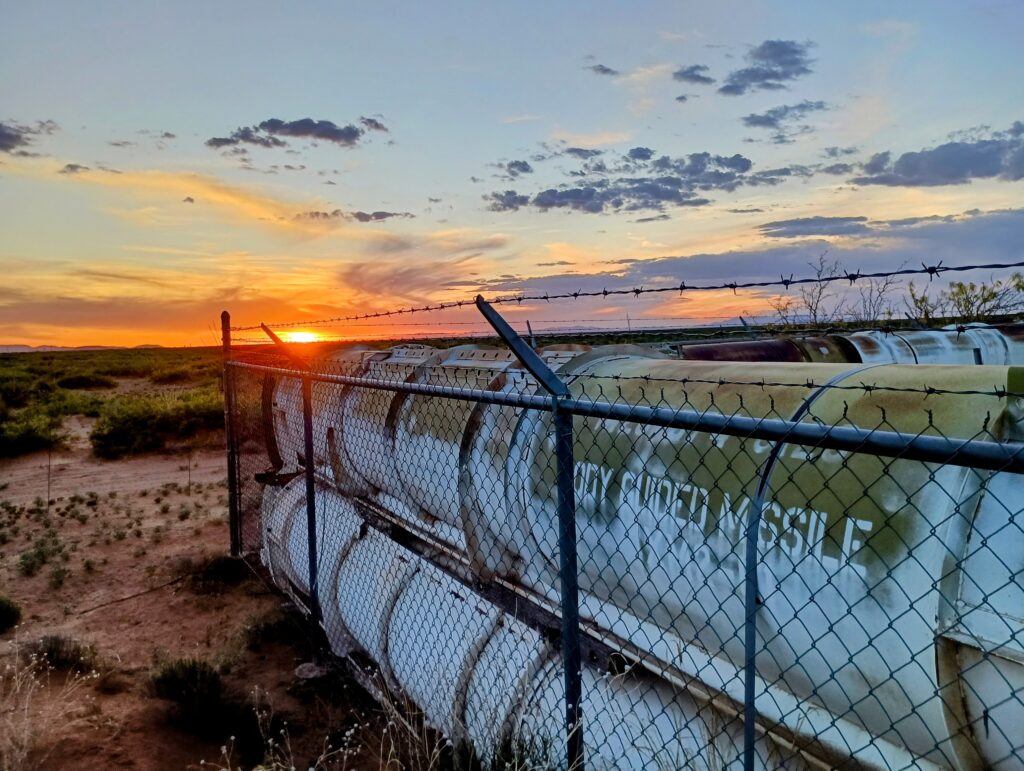
Decommissioned missile components behind a barbed-wire fence at sunset in the Chihuahuan Desert – Photo by Sam Jurado
Sam Jurado – Western Resource Fellow | Samuel Jurado is a PhD candidate in Environmental Sciences at the Yale School of the Environment, where he works as an environmental physicist specializing in wind erosion and dust dynamics. His research investigates the mechanisms of dust emission and the downstream impacts on human communities, with fieldwork based at the Jornada Experimental Range in
Southern New Mexico. Prior to Yale, Samuel earned a B.S. in Earth and Atmospheric Sciences with a concentration in Climatology from Cornell University, and went on to research land-atmosphere interactions at Harvard Forest. A native of El Paso, Texas, Samuel's work is rooted in a personal understanding of how wind, dust, and arid landscapes shape daily life in the
borderlands communities of the American Southwest. Blog